We Cant Go Home Again Nam June Paik
After exhaustive inquiry prior to conserving Untitled (Piano), it was time for reflection. MoMA curators and conservators discussed the difficult decisions alee. We knew that Nam June Paik playfully changed his works with each installation, and often incorporated new audio and video technologies into his older video sculptures. Should we continue this tradition, or freeze the existing technologies at the moment of his death?
The project that unfolded represents a series of negotiations, always followed by documenting our decisions for future staff and researchers.
Get-go nosotros decided to buy a full backup gear up of cathode ray tube (CRT) monitors. Paik preferred this technology even in the face of thin, flat screened models actualization on the marketplace. Ii of the monitors no longer worked. For these we purchased used monitors of the same size and swapped their cathode ray tubes with the originals, assuasive us to utilise the original monitor casings. This was carried out by CT Lui and Raphaele Shirley of CTL Electronics. CT Lui worked closely with Paik for many years and still runs a Telly repair shop off of Canal Street in New York Metropolis where he increasingly works for museums. We also purchased backups for the two security cameras, and extra bulbs for the spot light.
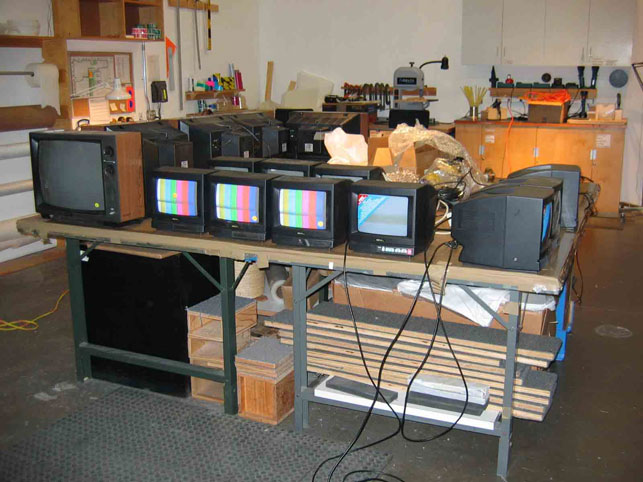
Testing the CRT monitors at MoMA. Photo: Glenn Wharton
Next came the pianoforte. Afterward farther word we decided to replace the original 5 ½" floppy-disc player-pianoforte unit of measurement, knowing that futurity repairs and disc replacement would be impossible considering of technical obsolescence. Fortunately PianoDisc, the company that made the unit of measurement, still exists. They now brand wireless units that play encoded MP3 files. We worked with Paul Keogler of Dancing Ivories on Long Island to supplant the unit and repair the piano. Our decision was to leave the original floppy-disc thespian-piano unit on the pianoforte as evidence of the original engineering, and install the new MP3 unit hidden away behind information technology.
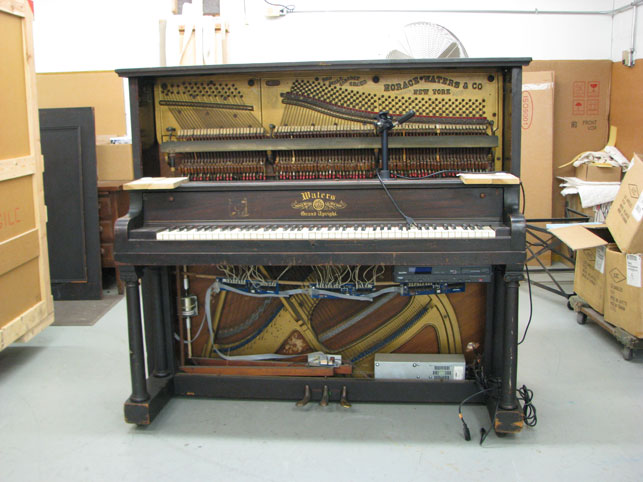
Original piano-player unit and exposed circuitry under the keyboard. Photograph: Glenn Wharton
Hopefully future staff will approve of our determination. Of course they can e'er remove the older unit or rewire the original unit in the future.
The piano itself was in poor condition. The wood was scratched and dented from use, and the mechanical systems were damaged and heavily restored. In one case again, our give-and-take led to nuanced decisions. We decided not to repair the wood, but replace the completely worn hammer shanks and felt pads.
The concluding stage of the project was to preserve the 2 videos that were on light amplification by stimulated emission of radiation discs. After determining that they were in proficient condition, we digitized them to create uncompressed files for archiving on our repository for digital collections.
I trouble was left unresolved. Now that the videos are in digital format, they can be played from a computer or other digital playback device. Should we hide this device behind a wall and leave the laser-disc play decks on the flooring since the artist approved this technology? Should we install footling green LED lights to make the decks appear like they are performance? Or would that be quack?
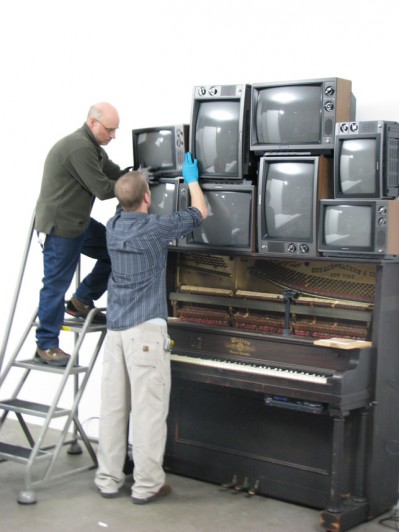
Installing the video sculpture after completing the conservation work. Photograph: Glenn Wharton
What would Nam June Paik exercise? The question haunts u.s.a. since he did not go out a clear roadmap for determination making in conserving his work. The decision nigh whether to display nonfunctioning light amplification by stimulated emission of radiation-disc play decks will be made past curators and conservators in the future, as they go along to keep the media sculpture alive past retaining sometime technologies, hiding new technologies, and inevitably alter the artwork.
Anthropologists tell united states that objects develop social biographies equally they accrue new meanings over time. A conservator would tell you that they have material biographies also. I am reminded of a comment made past the late Stanley Eveling, "An object is a wearisome consequence." Video sculptures must change materially over time as museum staff struggle to keep them operative. Their meanings inevitably modify, every bit society brings new understanding to older technologies and older art forms. Retaining an artist'southward vision for the piece of work while managing change is at the cadre of our work in the Museum. I can't aid just think that Nam June Paik is giggling at our inquiry and negotiation to keep the piano playing and the video rolling.
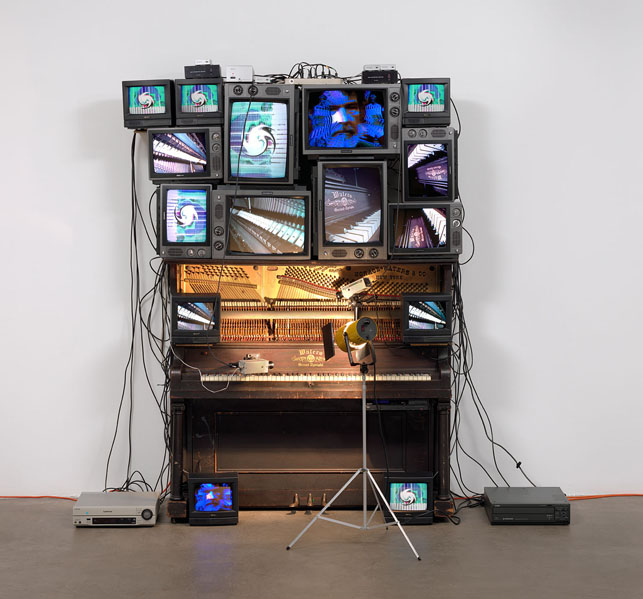
Nam June Paik. Untitled. 1993. Histrion piano, 15 televisions, two cameras, two laser disc players, i electric light and light bulb, and wires, overall approx. 8′ iv″ x 8′ 9″ 10 48″ (254 x 266.seven ten 121.nine cm), including light amplification by stimulated emission of radiation disc player and lamp. The Museum of Mod Art, New York. Bernhill Fund, Gerald S. Elliot Fund, gift of Margot Paul Ernst, and buy. © 2013 Manor of Nam June Paik
Source: https://www.moma.org/explore/inside_out/2013/05/08/conserving-a-nam-june-paik-altered-piano-part-2/
0 Response to "We Cant Go Home Again Nam June Paik"
Post a Comment